
















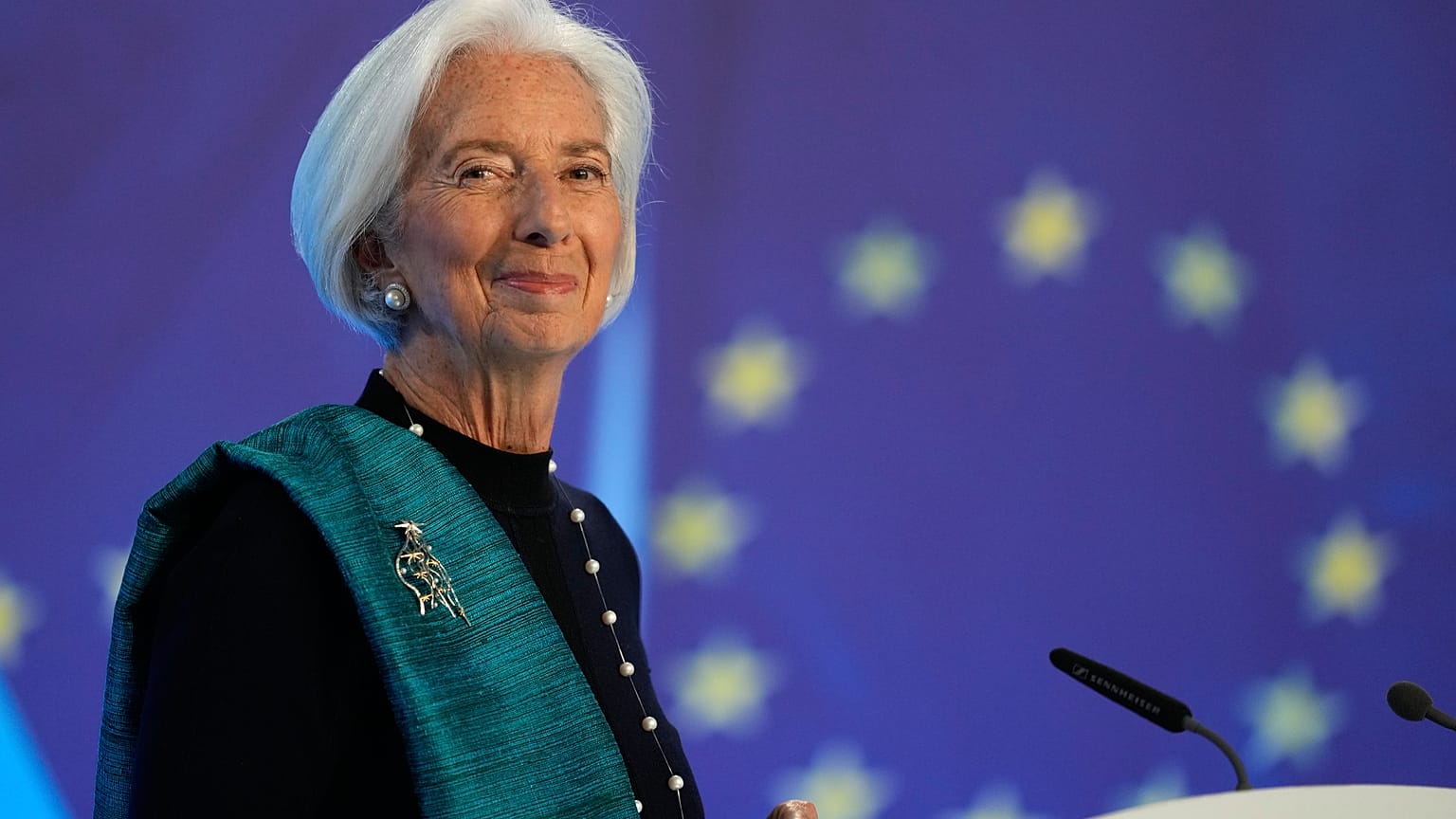













ECB President Christine Lagarde kept rates unchanged, citing persistent uncertainty and strong AI-driven investment.
European Central Bank President Christine Lagarde signalled that the euro area economy is undergoing a structural shift driven by artificial intelligence investment, while stressing that interest rate decisions will remain fully data-dependent amid persistently high uncertainty.
Speaking after the ECB’s final Governing Council meeting of the year, which unanimously decided to keep all three key interest rates unchanged, Lagarde said that monetary policy is “in a good place”.
However, she made clear that this assessment does not imply a fixed or predictable path for rates.
Interest rates: No guidance, all options open
Lagarde firmly ruled out providing forward guidance on interest rates, repeatedly emphasising the ECB’s meeting-by-meeting approach.
There was unanimous agreement among policymakers, she said, that “all optionalities should remain on the table”.
While acknowledging that current policy settings are appropriate, Lagarde cautioned that “good” does not mean “static”.
The Governing Council is closely monitoring wage growth, services inflation and global trade developments, all of which remain sources of uncertainty for the inflation outlook. That caution is reflected in the ECB’s latest staff projections.
The central bank now expects euro area growth of 1.4% in 2025, followed by 1.2% in 2026 and 1.4% in both 2027 and 2028, with domestic demand playing a larger role than previously assumed.
Inflation projections were revised slightly higher for 2026, reflecting a slower-than-expected decline in services inflation. Headline inflation is seen averaging 2.1% in 2025, easing below target in 2026 and 2027, before returning to 2.0% in 2028.
Lagarde underlined that wage dynamics and service prices will remain under close scrutiny given their importance for medium-term inflation persistence.
AI emerges as a key growth driver for the euro area
One of the most striking messages from the press conference concerned the composition of growth.
Investment is being driven by large corporations as well as small and medium-sized enterprises, with AI playing a central role. Spending has focused on computing capacity, telecommunications networks and intangible assets such as software and data, rather than traditional physical capital.
While acknowledging that AI could boost productivity over time, Lagarde cautioned against drawing premature conclusions about its impact on the so-called neutral interest rate.
In an environment marked by geopolitical shocks, trade fragmentation and persistent uncertainty, she argued that such structural parameters remain unobservable and were not discussed by the Governing Council at this meeting.
On digital euro and Russian frozen assets...
On the digital euro, Lagarde said the ECB has completed its technical and preparatory work and that responsibility now lies with political institutions.
The project, aimed at creating a public digital means of payment, is currently under consideration by the European Council and the European Parliament.
“Our ambition is to make sure that, in the digital age, there is a currency that acts as an anchor of stability for the financial system,” she said, framing the digital euro as a tool for monetary sovereignty rather than innovation for its own sake.
Lagarde also addressed the sensitive issue of whether frozen Russian central bank assets should be used to support Ukraine’s reconstruction.
While expressing confidence that European leaders will ultimately find a solution, she drew a firm line around the ECB’s mandate.
Any mechanism implying monetary financing, she warned, would violate EU treaties. Decisions on the use of frozen assets, in her view, remain the responsibility of political leaders, not central bankers.
How markets and experts reacted
Mohamed El-Erian, chief economic adviser at Allianz, praised Lagarde's performance, describing it as a “master class.”
He indicated the importance of her communication skills in stabilising market sentiment during periods of high economic uncertainty.
Roman Ziruk, senior market analyst at Ebury, said the ECB’s upgraded growth projections and cautious messaging helped support the euro against the dollar, alongside softer-than-expected US inflation data.
“Monetary policy remains in a ‘good place’,” Ziruk said, adding that persistent underlying price pressures strengthen the case against near-term interest rate cuts.
The euro held steady following Christine Lagarde’s press conference, trading around $1.1730, while German 10-year Bund yields remained broadly unchanged at 2.85%.
European equity markets advanced on Thursday afternoon, buoyed by a softer-than-expected US inflation report, which fuelled optimism about continued monetary easing by the Federal Reserve.
By 16:30 CET, the Euro STOXX 50 was up 0.8%, while Germany’s DAX index rose by approximately 1%.