
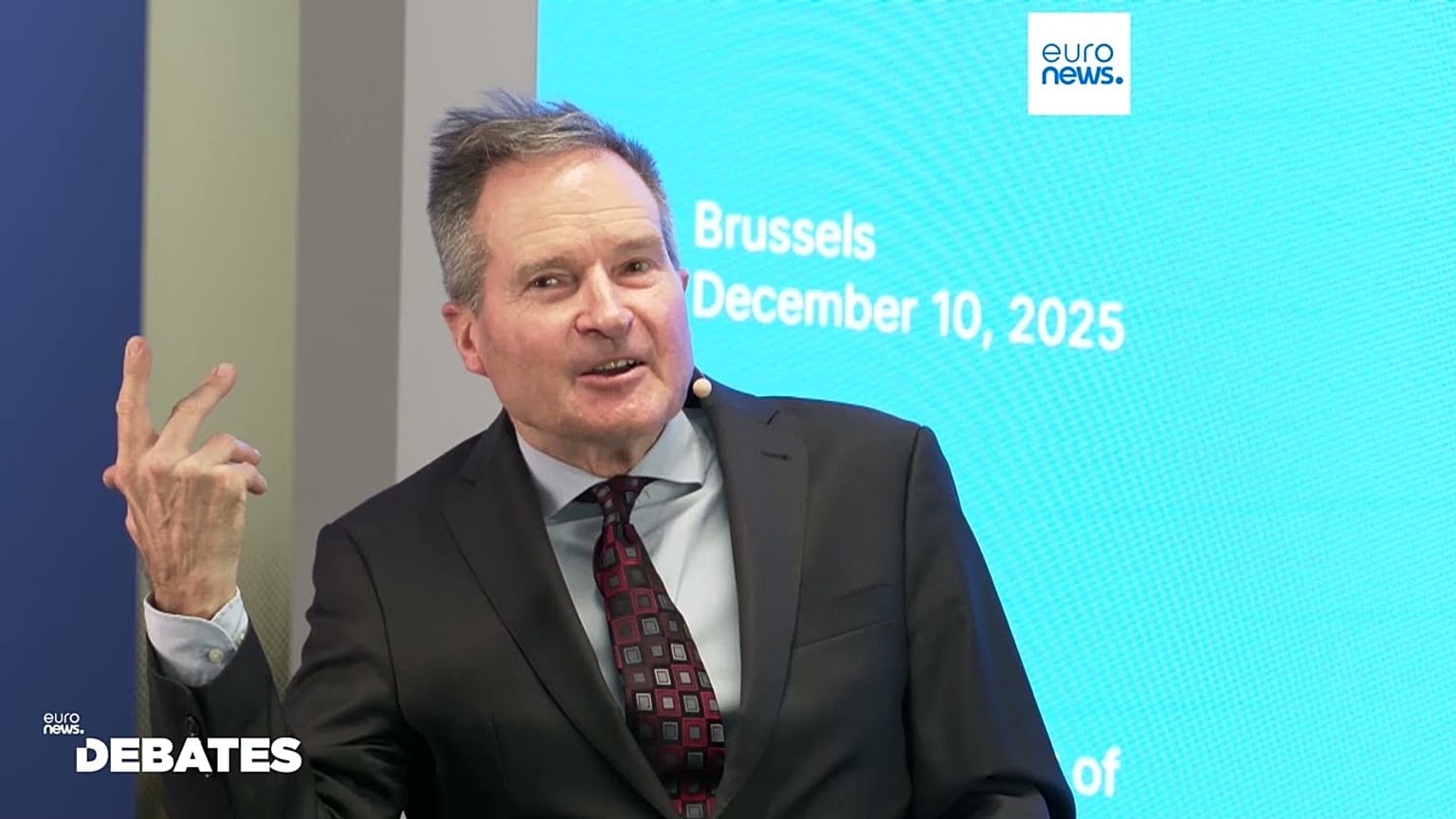













The ‘Accelerating European Competitiveness through Simplification’ Euronews debate brought together Czech ambassador to the EU Štěpán Černý and technology leaders from Qualcomm and Meta to discuss the simplification agenda.
Europe’s competitiveness push is colliding with an expanding regulatory rulebook, industry leaders warned at a Euronews debate in Brussels, arguing that the EU’s drive to simplify its digital laws and show regulatory restraint going forward is inseparable from its ability to compete globally.
The conversation recalled a recent letter from various leaders of EU member states which urged the European Council to ‘review, reduce, and restrain’, rethinking how Brussels regulates and calling for a substantial change in course. Yet with the AI Act, GDPR and the Digital Services and Markets Acts already reshaping the tech landscape, debate panellists said Europe is struggling to turn strong values into scalable innovation.
“The EU regulates and invests, but the trouble is there is no unified economic policy,” said Štěpán Černý, Permanent Representative of the Czech Republic to the EU. “After years of crises, simplification has become a call for strategic unity to reinvigorate economic growth.”
The message from the panel and EU member states is clearer than ever: Europe’s growth model needs urgent recalibration.
Regulation with good intentions, unintended consequences
The panel described a widening gap between political ambition and technical reality. Qualcomm’s Vice President of Government Affairs, Audrey Scozzaro Ferrazzini, said the EU’s approach often succeeds in principle but falters in practice, overwhelming firms that lack the resources to navigate multi-layered compliance.
“We are sophisticated enough that we can prepare before the policy text is fully adopted, but not everybody can have a team of lawyers helping them,” Ferrazzini said.
Meta’s Head of EU Affairs Marco Pancini pointed to the EU’s recent battery regulation as a cautionary tale. Rules designed around traditional consumer devices, he argued, do not match the design and engineering constraints of emerging wearable technologies. “There is a clash between the vision of the industry and of the regulators, not only at US level but at large.”
Across the sector, companies are navigating more than 250 regulators and 80 pieces of digital legislation adopted in five years. Pancini said the cumulative effect is hard to ignore. “It creates a burden of risk and complexity that is making it difficult for companies to innovate or thrive,” he said.
The single market that still isn’t single
Speakers stressed that Europe’s competitiveness challenge is rooted not only in new regulation but also in uneven implementation. Despite decades of integration, national deviations continue to fracture the internal market.
“National governments are arguing that we either act on the EU level or member states act alone and then we will see who wins in court,” Černý said, noting this attitude was regretful but unavoidable in the current climate.
Conversely, Ferrazzini highlighted the 3rd Generation Partnership Project (3GPP) from European Telecommunications Standards Institute (ETSI) as a prime example of how public-private partnerships can lead to inclusive technology development, enabling Europe to lead globally by unifying technical norms.
“[3GPP] is working well because it is inclusive and forward looking. “I see a lot of value here, not least as an example of how to enable the single market in other areas.”
AI Act: ambition meets complexity
The AI Act was repeatedly cited as legislation that aims high but demands more clarity.
An audience member — a legal adviser who reviewed the full text — described it as “a mess”, with 180 recitals and 113 articles. Ferrazzini agreed that complexity was creating similar friction in the industry, warning that short implementation timelines risked rushing crucial technical work.
For Pancini, the issue is not the Act’s values but its practical impact on uptake. Backed by the statistic that only 15 per cent of EU companies of more than 10 people adopted AI for their business in 2024, he cautioned that the Act was stifling innovation by creating undue risk for those wanting to uptake AI processes.
“This is a real concern and it’s causing European industry to lag behind,” Pancini said. “The cost of compliance is part of it.”
With hindsight, Pancini appealed for a more pragmatic approach. “We should take a step back, look at the legislative framework that we created and see if it addresses the goals and the fears we had when we passed it.”
Simplification, not deregulation
Černý rejected the idea that simplification equates to deregulation. “Nobody wants a business environment with zero rules or enforcement,” he said.
“The primary motivation for a simplification agenda is to create an understanding among member states of the need to foster economic growth,” Černý continued. ”Otherwise we cannot survive – economically nor geopolitically – in the challenging environment of today.”
Ferrazzini added that responsible business practices are increasingly market-driven and simplification should help industry rather than hinder it.
“As I understand it, the intent is not to waive fundamental rights but rather to remove some red tape for big and small companies,” she said. “It’s not black and white. Companies follow values because markets demand it.”
A future built on choices, not clutter
The panel discussion centred less on cutting regulation and more on the importance of prioritising strategically.
Ferrazzini argued that Europe’s real strength lies in its talent base but said scaling remains the continent’s Achilles heel. “If everything we do for the next five years goes innovation first and competitiveness first, and we execute fast, that would be a major win,” she said.
Pancini closed with a broader warning about Europe’s trajectory. “If we do not fall in love with the future, there will be no economy left to regulate,” he said. “Europe risks becoming a beautiful museum unless we create the conditions for productivity and jobs.”
As the debate wrapped up, Euronews moderator Chris Burns noted that the simplification agenda still has political momentum, even if its direction remains contested.
“This digital regulation story has legs,” he concluded. “The debate will go on.”